Dating back more than 2,000 years, the ancient history and myth of Swayambhunath Stupa centers around its deep identity as a “self-arisen” or self-created holy site, making it one of the oldest and most sacred Buddhist monuments in Nepal. Unlike other historic shrines built by human hands from the ground up, the word Swayambhu literally translates to “self-existent” or “created by itself.” According to ancient legends, the entire Kathmandu Valley was once a massive, deep lake, and a miraculous, radiant lotus flower bloomed naturally right in the middle of the water.
This brilliant flower emitted a powerful, divine light, which drew the great saint Manjushri to cut a gorge in the hills with his sword of wisdom, draining the water so that humans could walk to and worship this naturally born, holy flame. Today, the giant white dome and the iconic, all-seeing eyes of the Buddha painted on the stupa mark the exact spot where that primordial lotus once glowed, serving as a powerful global symbol of peace, cosmic awareness, and spiritual liberation.
Table of Contents
History and Myth of Swayambhunath Stupa
The Legend of the Primordial Lake and the Self-Arisen Lotus
Long before the Kathmandu Valley became a bustling, vibrant city, it was nothing more than a giant, calm, and incredibly deep body of water known as the Nagdaha, or the lake of snakes. For thousands of years, this enormous mountain lake remained quiet and untouched by human footsteps. However, everything changed when a miraculous event occurred right in the center of the waters. A magnificent, multi-colored lotus flower naturally grew out from the depths and bloomed brilliantly on the surface of the lake.
This was no ordinary plant; it was a divine creation that radiated an intense, eternal flame. This powerful, self-born light was a manifestation of pure wisdom and supreme cosmic energy, earning it the sacred name Swayambhu, which means “self-existent” or “created by itself.”
Word of this radiant, self-arisen lotus spread across different realms, eventually catching the attention of Manjushri, the great Bodhisattva of Wisdom, who was meditating in the distant mountains of China. Drawn by the incredible spiritual energy of the glowing flame, Manjushri traveled all the way to the edge of the great lake to pay his respects.
Upon seeing the holy lotus floating far out in the middle of the deep waters where no human could ever reach it to pray, he realized that the lake needed to be transformed. He decided that the water must be cleared away so that devout pilgrims could walk to the site, build a proper community, and worship the sacred light directly.
To turn this vision into reality, Manjushri drew his massive, gleaming sword of supreme wisdom and raised it high into the air. With one incredibly powerful strike, he sliced a deep, narrow gorge right through the southern hills of the valley at a place we know today as Chobhar.
The heavy mountain walls parted, and the immense volume of trapped water began to rush out through the new opening, completely draining the valley over several days. As the water level dropped, the fertile land underneath was finally revealed, and the hill where the radiant lotus rested gently settled onto the valley floor. That exact hill became the sacred foundation for the Swayambhunath Stupa, preserving the spot where the primordial, self-born light first blessed the earth.
Why is Swayambhunath Called the Monkey Temple?
While its official name is Swayambhunath Stupa, almost every international traveler and local guide knows this sacred hilltop as the Monkey Temple. The reason behind this unique nickname becomes obvious the moment you step foot near the entrance gates: hundreds of wild rhesus macaque monkeys roam freely across the stone stairs, swing from the colorful prayer flags, and nap on top of ancient shrines.
According to deep-rooted Buddhist mythology, these monkeys are not just random animals; they are considered holy and are strictly protected by the temple monks and local community. The legend says that the great Bodhisattva of Wisdom, Manjushri, was in the middle of building the original stupa on the hill. During this intense spiritual work, he chose to keep his hair exceptionally long. Over time, because of his long hair and deep meditation, his head became full of lice.
Instead of harming the tiny insects, the compassionate saint took them out and gently placed them into the dense trees surrounding the hill. Through his immense divine power, those head lice instantly transformed into the playful, agile monkeys that populate the forest today. Because they come from the hair of the God of Wisdom himself, the resident monkeys are viewed as sacred guardians of the stupa, adding a lively and unforgettable energy to the entire heritage site.
Essential Safety Rules for Interacting with the Holy Monkeys
Because these monkeys are completely accustomed to thousands of human visitors walking through their home every day, they are incredibly bold, highly curious, and quick to grab anything that catches their eye. To ensure you enjoy your cultural walk up the hill completely safely, keep these simple, practical rules in mind:
- Hide Your Food and Drinks Completely: Never walk around the temple grounds holding open snack packets, plastic shopping bags, or bottles of soda and water. The monkeys have excellent eyesight and will confidently jump onto your shoulders or arms to snatch food right out of your hands.
- Keep Your Bags Fully Zipped: Ensure your backpacks, daypacks, and camera bags are completely zipped shut at all times. Avoid hanging loose keychains, plush toys, or long straps from your bags, as these look like perfect toys to a curious baby monkey.
- Secure Your Glasses and Shiny Items: Monkeys love shiny, reflective objects. Before you start climbing the stone stairs, tuck away your sunglasses, expensive jewelry, and loose hats inside your bag. If you are taking photos with your phone or camera, hold onto them tightly with a wrist strap.
- Never Make Direct Eye Contact: In the animal world, staring directly into a monkey’s eyes for more than a few seconds is viewed as a serious threat or a challenge to a fight. If a monkey looks your way, simply glance down or look past them smoothly and keep walking.
- Avoid Showing Your Teeth: Be careful when smiling for photos near the monkeys. To them, baring your teeth (even in a happy camera smile) looks exactly like a display of aggression or a warning that you are about to attack. Keep a relaxed, closed-mouth expression when they are close by.
Swayambhunath Stupa Opening Hours and Entry Fee
Planning your visit with the right logistical details ensures a smooth and stress-free experience at the Monkey Temple. Swayambhunath Stupa is open to visitors 24 hours a day, 7 days a week, meaning you can visit at any time. However, the inner ticket counters and the main heritage monuments are officially active from 5:00 AM to 7:00 PM daily.
To enter the main stupa area, international travelers must pay a standard entry fee, which goes directly toward the preservation and maintenance of this ancient UNESCO World Heritage Site. The financial investment for entry tickets is broken down by nationality:
- Foreign Nationals: NPR 200 per person.
- SAARC Nationals: NPR 50 per person (applicable to visitors from South Asian countries like India, Bangladesh, Bhutan, Sri Lanka, Maldives, and Pakistan).
- Local Devotees & Children: Entry is completely free.
Note: Make sure to carry cash in Nepalese Rupees (NPR) to purchase your tickets, as the official counters at the gates do not accept digital payments or foreign currency.
How Many Steps to Swayambhunath Temple?
When deciding how to reach the top of the hill, you have two entirely different routes to choose from: the traditional, physical stairs or the modern driving road.
The 365-Step Challenge (The Eastern Entrance)
For the ultimate cultural and spiritual experience, most travelers choose to climb the iconic 365 ancient stone steps leading up the eastern face of the hill. Each step represents a single day of the year.
This path is a steep but incredibly rewarding physical challenge. As you make your way up under the shade of massive green trees, you will be accompanied by playful monkeys, ancient stone sculptures, and local devotees spinning prayer wheels. Climbing the stairs allows you to experience the temple exactly as pilgrims have for thousands of years. The grand reward at the very top is stepping directly onto the main platform right in front of the giant, all-seeing eyes of the Buddha.
The Western Driving Road (The Easy Access Route)
If you are traveling with young children, elderly family members, or simply want to avoid a strenuous uphill climb, you do not have to walk up the stairs. There is a fully paved driving road that winds up the backside (western side) of the hill.
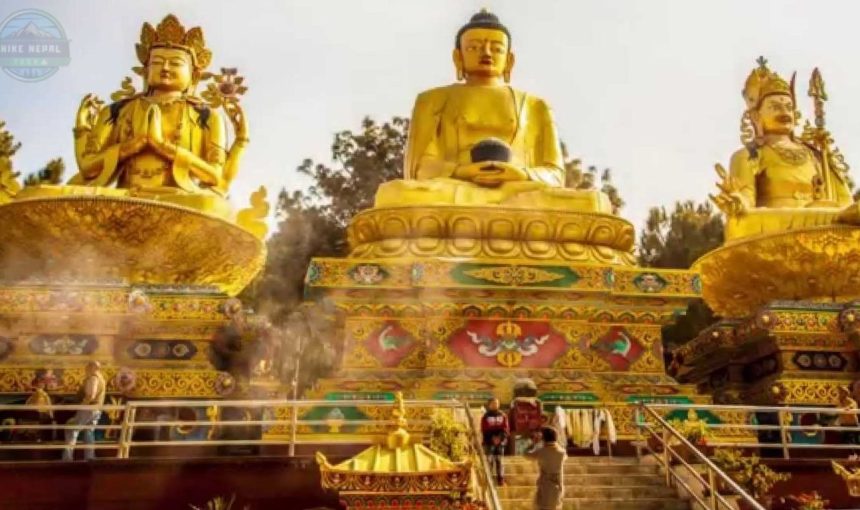
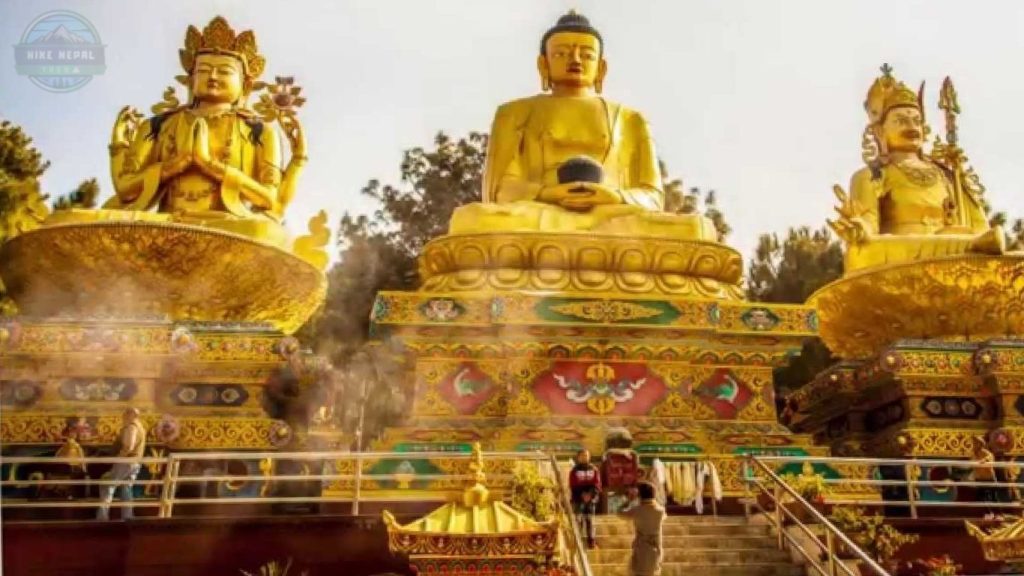
Your taxi or private vehicle can drive you all the way up to the western parking lot, which sits right near the top of the ridge. From this upper parking area, it is just a short, flat, 5-minute walk along a paved path past the Three Buddhas Park to reach the main stupa. This alternative route makes the entire heritage site completely accessible to everyone, regardless of physical fitness.
Best Time to Visit Swayambhunath for Sunset and Sunrise
Peace and Devotion (5:30 AM – 7:30 AM)
Arriving at Swayambhunath just before dawn is one of the most serene cultural experiences you can have in the Kathmandu Valley. During the early morning hours, the tourist crowds are entirely absent, leaving the hilltop to local Buddhist and Hindu devotees. As you climb the stairs, you will walk alongside locals chanting their morning prayers, spinning the brass prayer wheels, and feeding the resident monkeys.
Watching the sunrise from the eastern viewpoint allows you to see the first golden rays of light pierce through the morning mist, slowly illuminating the sprawling city below. The crisp morning air, the smell of burning incense, and the sound of distant temple bells create a deeply spiritual and meditative atmosphere that is perfect for quiet contemplation.
The Golden Hour Panorama (5:00 PM – 6:30 PM)
If your primary goal is breathtaking photography and dramatic landscapes, the late afternoon leading into sunset is the absolute best time to visit. Because the stupa sits on a high, isolated hill, it offers an unobstructed, 360-degree panoramic view of the entire Kathmandu Valley ringed by distant mountain peaks.
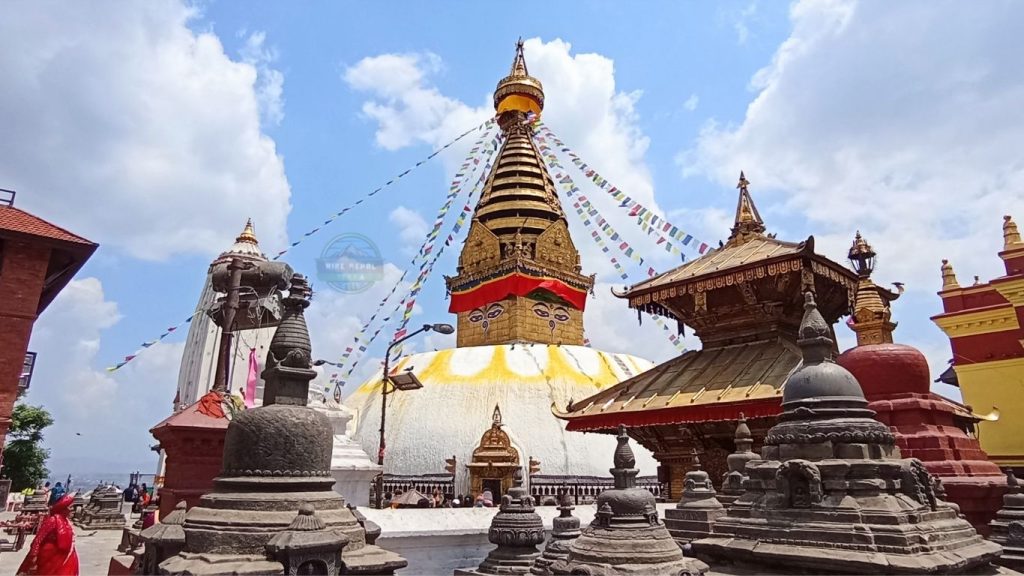
Aim to arrive at the main platform by 5:00 PM to capture the “Golden Hour.” As the sun begins to dip behind the western hills, the entire white dome of the stupa glows with a brilliant orange and gold light, making the painted eyes of the Buddha look incredibly striking. After the sun sets, stay for an extra 20 minutes to watch the city lights slowly twinkle to life across the valley floor while the evening breeze rustles through thousands of colorful prayer flags.
Frequently Asked Questions About the Monkey Temple
Is Swayambhunath a Buddhist or Hindu temple?
Swayambhunath is a beautiful example of the religious harmony found in Nepal. While it is primarily one of the most sacred Buddhist pilgrimage sites in the world, it is deeply revered and actively worshiped by Hindus as well. Within the complex, right alongside the main Buddhist stupa, you will find several Hindu shrines and statues, including the Harati Temple dedicated to the goddess of smallpox and children.
Why do the painted eyes on the stupa have a curly symbol where the nose should be?
The iconic face painted on all four sides of the stupa cube features the all-seeing eyes of the Buddha looking out in compassion. The symbol that looks like a question mark or a curly nose is actually the Nepali number “1” (Ek in the Devanagari script). It represents unity—reminding all who look at it that there is only one ultimate path to spiritual enlightenment, and that all living beings are interconnected. Above the eyes, you will also see a small dot representing the Buddha’s third eye, symbolizing cosmic wisdom.
Can you take photos and videos inside the Swayambhunath complex?
Yes, photography and videography are fully permitted in almost all the open public areas around the hilltop. You can take stunning photos of the panoramic valley views, the prayer flags, the monkeys, and the main stupa itself. However, out of respect for local devotees, you should always ask for permission before taking close-up portraits of people praying or meditating. Additionally, flash photography and recording are strictly prohibited inside the small, dark inner shrine rooms where priests perform sacred daily rituals.
How much time do you need to fully explore the Monkey Temple?
To truly appreciate the site without rushing, you should plan to spend about 1.5 to 2 hours at the temple. This gives you plenty of time to slowly climb the 365 ancient stone steps, take a few resting breaks to observe the monkeys, circle the main dome clockwise to spin the prayer wheels, and enjoy a quiet drink at one of the rooftop cafes while soaking in the panoramic views of the Kathmandu Valley.